MEDIA RELEASE COMMUNIQUE AUX MEDIAS MEDIENMITTEILUNG
Our new Dementia in Europe policy magazine is available for download!
3 June 2025, Brussels - Today, at a series of meetings held in Brussels (Belgium), including a Company Round Table with sponsors, a European Parliament Lunch Debate with MEPs, and a Public Affairs meeting with its national member associations, Alzheimer Europe is launched the 48th edition of its "Dementia in Europe" policy magazine, together with a supplement about the EU-funded AI-Mind research project. Both publications are available for download, as well as available in print.
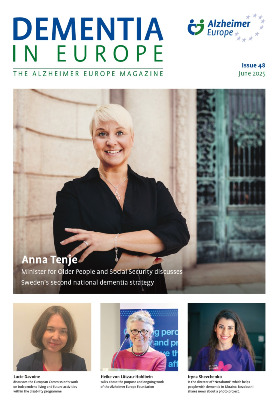
It is with great pleasure that we introduce the 48th edition of our Dementia in Europe magazine, which brings updates on interesting developments across Europe in relation to policy, research, culture, advocacy and dementia care, throughout the first few months of 2025.
The first section shares some of our own work, starting with an article about our successful Alzheimer’s Association Academy held in January, focusing on the topic of “Engaging in health technology assessment and pricing and reimbursement processes” at which our national member associations were invited to learn from four excellent speakers: Neil Bertelsen from Patient Focused Medicines Development, Elizabeth Walker, Technical Advisor at the UK’s National Institute for health and Care Excellence (NICE), Matteo Scarabelli, Associate Director for Market Access at the European Federation of Pharmaceutical Industries and Associations (EFPIA) and Jim Pearson, Deputy Chief Executive of Alzheimer Scotland.
The following article is an interview with Heike von Lützau-Hohlbein, Chairperson of the Alzheimer Europe Foundation, in which she looks back at over a decade of the Foundation’s work, after which we report on a recent meeting of the European Working Group of People with Dementia (EWGPWD) that we were delighted to host in Luxembourg in March of this year. As part of this meeting, the EWGPWD provided feedback on digital exergame and Artificial Intelligence chatbot developed by the eBRAIN-Health project.
The final three articles in this section present work by other EU-funded projects in which we are involved, including ADIS, which has launched a Spanish-language brain health initiative on social media, aimed at young adults in their early twenties, LETHE, which is developing innovative digital tools to support older adults in enhancing their cognitive health, and INTEREST, which presents its recommendations for dementia research, care, and policy.
Our Policy Watch section opens with the excellent news that the Swedish Government has launched its second national dementia strategy, “Every Day Counts: National Dementia Strategy 2025-2028”, which builds on the country’s previous plan. We hear from Minister for Older People and Social Security, Anna Tenje, and from Liselotte Björk, Chair of Demensförbundet, our national member association in Sweden.
The remaining articles in this section move us from the national to the European level, where we first introduce the recently-launched EU Joint Action addressing Dementia and Health (JADE Health). Co-ordinators Elisabeth Garcia and Bernardino Morillo, tell us more. Up next, we explore the EU4Health Civil Society Alliance (CSA) campaign for sustainable funding, through the eyes of the CSA Secretariat, Clémentine Richer Delforge from the European Public Health Alliance and Yann Heyer from the European Patients’ Forum. Finally, we approached Acting Head of Unit for Disability at the European Commission, Lucie Davoine, who outlines some key developments in disability policy and highlights their relevance for people living with dementia.
The third and final section of this magazine is the “Dementia in Society” section, where we begin with an article celebrating the 40th anniversary of our national member association in France. Lorène Gilly, who is responsible for public policy at France Alzheimer, tells us about the celebrations and shares some highlights from the past four decades of vital work carried out by the organisation, to improve the lives of people with dementia and carers. Staying at the national level, we then look at an important photography project from our member in Ukraine. “Nezabutni” (“Unforgettable”), is spreading the message that people with dementia deserve happy and fulfilled lives, the same as everyone else, and the Ukrainian charity has put together a series of photo portraits of ten people with dementia and their family members, sharing their stories to help break down some of the stigma and misconceptions around the condition. We salute the hard work and “we never close” attitude of our Ukrainian colleagues, during this incredibly difficult time for the country and its people.
Turning next to the United Kingdom, we showcase the new “Dementia Trials Accelerator”, spearheaded by the UK Dementia Research Institute (UK DRI) and Health Data Research UK (HDR UK) and supporting the UK Government’s Dame Barbara Windsor Dementia Goals programme (formerly known as the Dame Barbara Windsor Dementia Mission). The Dementia trials Accelerator aims to tackle the historically low numbers of people enrolled into dementia trials in the UK. Prof. Siddharthan Chandran, UK DRI Director, and Prof. Andrew Morris, HDR UK Director, provide details.
Our closing article takes a look at documentary film “Human Forever”, a story about love for humanity told by people with dementia, in which 25-year-old humanitarian activist Teun Toebes takes the viewer on a three-year journey across four continents and through 11 countries, exploring how dementia is dealt with in other countries and what we can learn from each other. This impressive quest was captured by his good friend and filmmaker Jonathan de Jong.
We hope you enjoy this edition of our Dementia in Europe magazine and make the most of the summer months ahead!
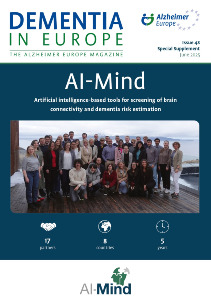
The Special Supplement to the 48th edition of Dementia in Europe magazine is a publication dedicated to the AI-Mind project, which is an initiative funded by the European Union’s Horizon 2020 research and innovation programme.
At the heart of the AI-Mind project is the development of innovative Artificial Intelligence (AI)-based tools designed to screen brain connectivity and estimate dementia risk. These tools are designed to assist healthcare professionals in diagnosing dementia, ultimately enabling timely interventions for patients.
The AI-Mind project is a five-year research and innovation programme that has been growing since its launch in March 2021, expanding from 15 to 17 partners across eight European countries. AI-Mind brings together professionals from multiple sectors, including academic institutions, medical centres, small and medium-sized enterprises, spin-off companies and patient associations, with a common goal of providing future patients with a better and personalised diagnosis.
 It is with great pleasure that we introduce the 48th edition of our Dementia in Europe magazine,
  The Special Supplement to the 48th edition of Dementia in Europe magazine is a publication